Roof maintenance
Roofing Contractor in Queens: Flat Roof vs. Pitched Roof Maintenance Explained
Legacy Construction NYC Corp · · 9 min read
Flat and pitched roofs fail differently, age differently and need different maintenance habits. Here is how to tell which one you have, what each needs, and how often to schedule an inspection.
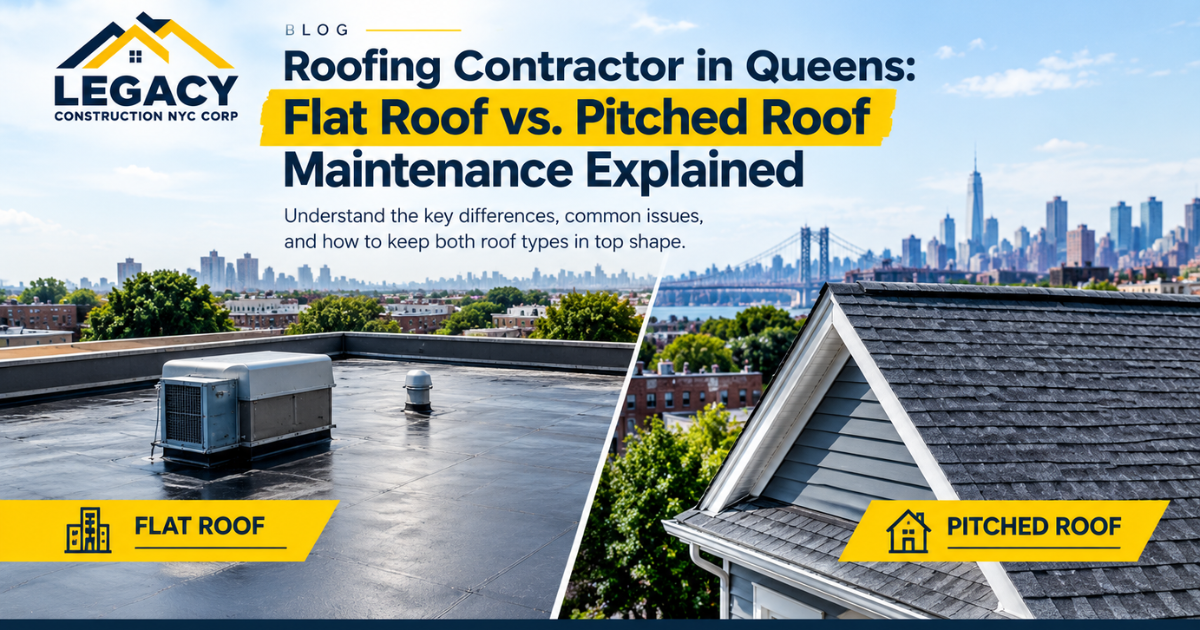
If you own property in Queens, there's a good chance your roof falls into one of two very different categories: flat (or low-slope) and pitched. The two systems shed water differently, age differently, and fail in different ways, which means they also need different maintenance plans and, often, different expertise from the contractor you hire. Homeowners searching for Queens roofing help sometimes assume any local roofer can handle either type equally well. In practice, the materials, tools, and inspection points are specific enough that understanding your roof type first will save you time, money, and a few unnecessary phone calls.
This guide walks through how flat and pitched roofs differ, what maintenance each one actually requires, the warning signs worth watching for, and how often a professional visit makes sense. Whether you're maintaining a rowhouse with a built-up flat roof in Ridgewood or a shingled single-family home in Bayside, the goal is the same: catch small problems before they become expensive ones.
Why Roof Type Matters When Choosing a Contractor in Queens
Queens has an unusually mixed housing stock. Attached and semi-attached homes, especially in neighborhoods with rowhouses and older multi-family buildings, frequently have flat or low-slope roofs. Detached single-family homes, particularly in areas with more suburban-style construction, are more likely to have pitched, shingled roofs. Commercial buildings along major corridors almost always use flat roofing systems because they're easier to build over large spans and accommodate rooftop equipment.
That variety means a Queens roofing companies search often turns up contractors with very different specialties. Some crews spend most of their time on membrane roofing for apartment buildings and commercial properties. Others focus almost entirely on asphalt shingle work for single-family homes. Neither is "better" — they're just different trades that happen to share the word "roofing."
Whether a property needs commercial roofing in Queens for a mixed-use or multi-family building, or residential roofing in Queens for a single-family home, matching the contractor's specialty to the roof type is one of the most useful things a property owner can do before hiring. You can see the full range of services we handle across both systems.
Materials and Techniques Vary by Roof Type
Flat roofs rely on continuous waterproof membranes — materials like EPDM rubber, TPO, PVC, or layered modified bitumen — because there's no slope to let water run off quickly. Every seam, drain, and penetration has to be sealed correctly, and repairs typically involve patching or reinforcing the membrane itself.
Pitched roofs use overlapping materials, most commonly asphalt shingles in this region, though wood shake, slate, and metal panel roofs also show up on older or higher-end properties. Water sheds by gravity across the overlapping courses, so the maintenance concerns center on individual shingles, flashing details, and the points where the roof plane changes direction or meets a vertical surface like a chimney or wall.
Because the failure points and repair techniques are different, the tools, materials, and even the safety equipment a crew brings to the job differ as well.
Why Some Contractors Specialize in One Roof Style
A contractor who works primarily on commercial flat roofs may not do much residential shingle work in a given year, and the reverse is just as common. This isn't a red flag — it's a reasonable way for a business to build deep expertise in one system. When you're evaluating a contractor, it's worth asking directly how much of their recent work has involved your specific roof type, rather than assuming general roofing experience covers both equally well.
Flat Roof Maintenance: What Queens Homeowners Need to Know
Flat roofs don't fail dramatically most of the time — they fail slowly, through small issues that go unnoticed until water finds its way inside. Good flat roof maintenance is really about catching those small issues early.
Ponding Water and Drainage Problems
Because flat roofs have little to no slope, some ponding after rain is common on almost every system. The concern is water that sits for more than 48 hours, which can accelerate membrane wear, contribute to leaks at seams, and in colder months, freeze and expand in ways that stress the roofing material. Ponding usually points to one of a few underlying issues: a low spot in the roof deck, a clogged or undersized drain, or debris blocking water from reaching the drainage system.
A simple maintenance habit — clearing leaves and debris from drains and roof edges each season — prevents a large share of the drainage problems that otherwise show up as interior leaks months later. Scheduled gutter cleaning covers most of that work on a typical property.
EPDM, TPO, and Modified Bitumen Repairs
Each flat roofing material has its own maintenance profile. EPDM (a synthetic rubber membrane) is generally repaired with specialized seam tape or liquid adhesive designed for that material. TPO, a heat-welded plastic membrane, typically requires hot-air welding equipment to properly reseal a seam rather than adhesive alone. Modified bitumen, a layered asphalt-based system, is often repaired with heat or torch-applied patches matched to the existing layers.
Using the wrong repair method on the wrong membrane type is a common cause of recurring leaks, which is one reason it's worth confirming that a contractor has specific experience with your roof's material before authorizing repair work.
Pitched Roof Maintenance: Common Issues and Fixes
Pitched roofs shed water more efficiently by design, but that doesn't mean they're maintenance-free. Most pitched roof repair calls trace back to a handful of recurring issues in the roof's individual components — shingles, flashing, vents, and valleys — each with their own wear points.
Shingle Wear From Weather Exposure
Asphalt shingles are built to handle sun, rain, wind, and temperature swings, but years of exposure gradually take a toll. Watch for shingles that are curling at the edges, losing their granule coating (visible as bald or shiny patches), cracking, or missing entirely after a windstorm. Granule loss in particular is worth monitoring, since it's often an early sign that a shingle's protective layer is breaking down.
Queens winters bring freeze-thaw cycles that can be tough on aging shingles, especially if ice forms along the roof edge and backs up under the shingle courses — a condition often called ice damming. Homes with poor attic ventilation or insulation are more prone to this because warm air escaping into the attic melts roof snow unevenly, creating the conditions for ice dams to form near the eaves. FEMA also recommends keeping gutters and downspouts clear and directing roof runoff away from the building as part of routine property maintenance. Snow and ice dam removal is a seasonal service worth arranging before the first heavy snowfall.
Flashing and Chimney Leak Points
Flashing — the metal strips installed where the roof meets chimneys, walls, skylights, and vents — is one of the most common sources of pitched roof leaks, often more so than the shingles themselves. Flashing can loosen, corrode, or separate from the surface it's sealed against over time, particularly around older masonry chimneys where the mortar joints have also aged. A visual check for gaps, rust, or lifted edges around these transition points is one of the more valuable things a homeowner can do between professional inspections.
Flat Roof vs. Pitched Roof: A Quick Comparison
| Feature | Flat / low-slope roof | Pitched roof |
|---|---|---|
| Common materials | EPDM, TPO, PVC, modified bitumen | Asphalt shingles, wood shake, slate, metal |
| Typical failure point | Membrane seams, drains, ponding areas | Flashing, individual shingles, valleys |
| Common building types | Attached homes, multi-family, commercial | Detached single-family homes |
| Water drainage | Relies on slope and drains; ponding is possible | Sheds water by gravity across the slope |
| Repair approach | Membrane patching, welding, or sealant matched to material | Shingle replacement, flashing resealing |
How Often You Should Schedule a Roof Maintenance Visit
Both roof types benefit from routine, planned inspections rather than waiting for a visible leak. The right frequency depends on the roof's age, material, and exposure, but these general roof maintenance tips work well as a seasonal rhythm for most Queens properties.
Seasonal Maintenance Schedule
A spring inspection after winter's freeze-thaw cycles and a fall inspection before cold weather sets in cover the two periods when roofs in this climate tend to take the most stress. Spring checks typically focus on identifying any damage from winter ice or heavy snow load, while fall checks are about clearing debris, checking drainage, and confirming the roof is sealed before winter weather arrives. NYC Department of Buildings guidance likewise advises property owners to make sure gutters, roof drains and downspouts are clear of debris before severe weather. Commercial and multi-family flat roofs, especially those with rooftop equipment, often benefit from an additional mid-summer check since heat and UV exposure peak during that period.
Signs You Need an Off-Cycle Inspection
Certain situations call for an inspection outside the normal schedule: after a significant storm with high winds or heavy rain, after noticing a water stain on an interior ceiling or wall, after seeing granules collecting in gutters, or after any visible sagging on a flat roof section. These aren't necessarily emergencies, but they're worth addressing before the next scheduled maintenance visit rather than waiting.
Maintenance Checklist for Queens Homeowners
- Clear leaves and debris from drains, gutters, and roof edges each season
- Check for ponding water that lasts more than a day or two after rain
- Look for curling, cracked, or missing shingles from the ground or a safe vantage point
- Inspect flashing around chimneys, skylights, and vents for gaps or rust
- Watch for interior water stains, peeling paint, or musty odors near the attic or top floor
- Schedule a professional inspection at least twice a year, plus after major storms
- Confirm attic ventilation is adequate, especially before winter
What to Do If You Notice a Problem
If you spot a leak, sagging area, or storm damage, the safest first step is a visual check from the ground or an interior inspection of the attic or top-floor ceiling — climbing onto the roof yourself, particularly a pitched one, carries real fall risk and isn't necessary for an initial assessment. From there, documenting what you see with photos and noting when it started helps a contractor diagnose the issue faster.
Active leaks, sagging roof decking, or exposed roof structure after storm damage are situations where it's worth calling a professional promptly rather than waiting for a scheduled visit, since water intrusion tends to cause more damage the longer it continues. For those situations, emergency roof repair is the faster route.
Choosing a Contractor for Your Roof Type in Queens
Because flat and pitched roofs require different materials and repair techniques, it's reasonable to ask a prospective contractor directly about their experience with your specific roof type before scheduling work. A contractor who is transparent about what they specialize in and who inspects before quoting a repair is generally a better sign than one offering a price without seeing the roof first. You can read more about our team and how we work.
A Final Word on Roof Maintenance in Queens
Flat and pitched roofs fail differently, age differently, and need different maintenance habits — but both benefit from the same basic principle: regular, planned attention catches small issues while they're still inexpensive to fix. Whether your property has a membrane roof over an attached rowhouse or a shingled roof over a detached home, knowing what to look for between professional visits makes a real difference in how long the roof lasts.
Legacy Construction NYC Corp works with both flat and pitched roofing systems across Queens, from routine seasonal inspections to targeted repairs on membrane and shingle roofs alike. If you've noticed ponding water, damaged shingles, or a leak that needs a closer look, an inspection is the most reliable way to understand what's actually happening and what it will take to fix it properly. For general roofing assistance or to discuss your property, contact Legacy Construction NYC Corp or request a free estimate.
Reviewed by Legacy Construction NYC Corp roofing team, Licensed & insured New York roofing contractors
Frequently asked questions
What's the difference between a flat roof and a pitched roof?
A flat roof has little to no slope and relies on a continuous waterproof membrane, such as EPDM, TPO, or modified bitumen, to keep water out. A pitched roof has an angled surface that sheds water by gravity, typically using overlapping materials like asphalt shingles.
How often should a flat roof be inspected in Queens?
Most flat roofs benefit from at least two inspections a year, generally in spring and fall, with an additional check after any major storm. Commercial roofs with heavy rooftop equipment or foot traffic may need more frequent attention.
What causes ponding water on a flat roof?
Ponding is often the result of a low spot in the roof deck, clogged or undersized drains, or debris blocking normal water flow. Occasional ponding after rain is common, but water that sits for more than a day or two is worth having evaluated.
Can one contractor handle both flat and pitched roofs?
Some contractors do work on both, but the materials and repair techniques are different enough that many crews specialize in one type. It's worth asking about a contractor's specific experience with your roof style before hiring.
How long does flat roof repair take?
This depends heavily on the extent of the damage and the membrane material involved. A small seam repair might be completed in a single visit, while larger membrane replacement or drainage corrections can take longer. A contractor can typically give a more specific timeline after inspecting the roof.
What's the average lifespan of a flat roof in NYC?
Lifespan varies by material and how well the roof has been maintained — membrane type, installation quality, and drainage all play a role. Regular inspections and prompt repairs tend to extend a flat roof's useful life regardless of the material used.